Coffee market

The green coffee market remains volatile. In late July, arabica and robusta prices were being pulled at once by the weather in Brazil, the pace of the harvest and expectations of higher world coffee production in the 2026/27 season.
The two main segments of the market are moving differently, though: arabica supply for nearby shipment remains limited, while robusta is becoming gradually easier to source.
Arabica prices: the harvest is speeding up, but supply stays limited
Heavy rain in Brazil over recent weeks delayed the picking and drying of coffee and supported the rise in arabica prices. Forecasts of mostly dry weather, however, point to a faster harvest ahead.
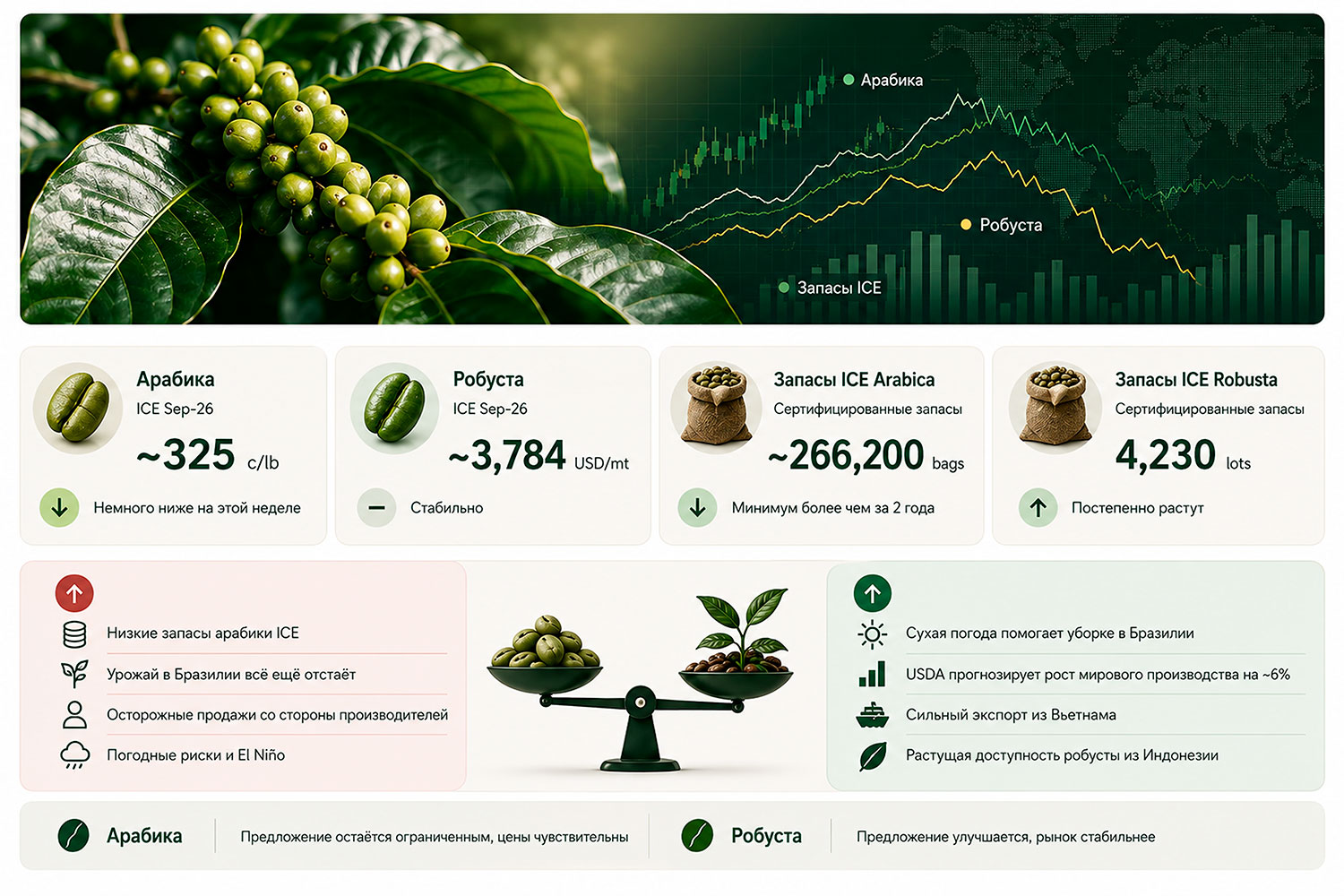
The September ICE arabica contract stood at around 325 cents per pound, easing slightly after hitting a two-week high.
Despite the better weather, the Brazilian coffee harvest is still behind both last year's pace and the five-year average. As the pick accelerates, the availability of coffee for export should gradually increase.
Arabica stocks remain low in the meantime. ICE certified stocks have fallen to around 266,200 bags — the lowest level in roughly two and a half years. Limited supply of coffee for nearby shipment continues to support prices even as production forecasts improve.
Current Brazilian green coffee offers can be found in the Green Coffee Hub catalogue.
Robusta prices are holding steadier
The robusta market looked more balanced at the end of July. The September ICE contract stood at around $3,784 per tonne, while certified robusta stocks grew steadily to 4,230 lots.
Vietnam remains one of the main drivers. Coffee exports from the country are holding at a high level and the production outlook is improving. That is adding to robusta supply on the world market.
In Indonesia the harvest is also continuing in mostly favourable weather, which further increases the robusta available for export.
As a result, in the short term robusta prices may hold steadier than arabica prices, provided the market does not run into serious weather risks.
The Green Coffee Hub range also includes Vietnam Robusta Wet Polished.
World coffee production may grow
The medium-term outlook for the world coffee market is gradually improving.
According to USDA data cited in the CCR report, world coffee production in the 2026/27 season could rise by around 6% to a record level. Brazil is also expected to bring in a significantly larger crop than in the previous season.
If those forecasts hold, green coffee supply could increase in the second half of the season and ease the pressure on prices.
Two opposing forces are therefore at work on the market at once: limited stocks are supporting arabica prices in the short term, while expectations of higher world production are improving the supply outlook further out.
The weather remains the main risk for the coffee market
Even with better harvesting conditions in Brazil, the weather remains one of the main sources of uncertainty for the world coffee market.
Market participants continue to watch weather developments linked to El Niño. The coffee flowering period in Brazil in September and October will be especially important, as it shapes the outlook for the next crop.
Over the coming months, then, price movements will depend not only on current stock levels and export volumes, but also on the weather in the main coffee-producing regions.
What this means for roasters and green coffee buyers
In today's arabica market, supply for nearby shipment remains relatively limited, while the robusta situation is gradually becoming more stable.
When planning purchases it is worth watching several things at once: the progress of the Brazilian harvest, the trend in ICE stocks, export volumes from Vietnam and the weather in the key producing countries.
Current varieties, origins and available lots of green coffee for roasting can be found in the Green Coffee Hub catalogue.
Based on market reviews by Central Coffee Roasting (CCR).